Or start from a description
Describe a decision, process or mechanism to your AI assistant and get back a model you can run and check. Some to open on sim.pflow.xyz:
Example models, open in the editor
Each one is a saved net with a content-addressed ID. Open it, change a weight, run it. The same kind of model is what sim.pflow.xyz builds from a description.
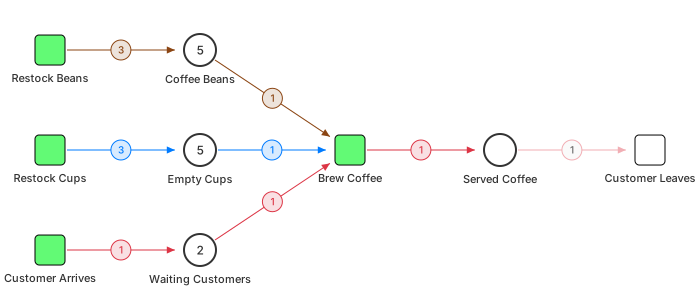
Coffee Shop
Weighted arcs encode recipes, conservation laws guarantee you never oversell a latte.
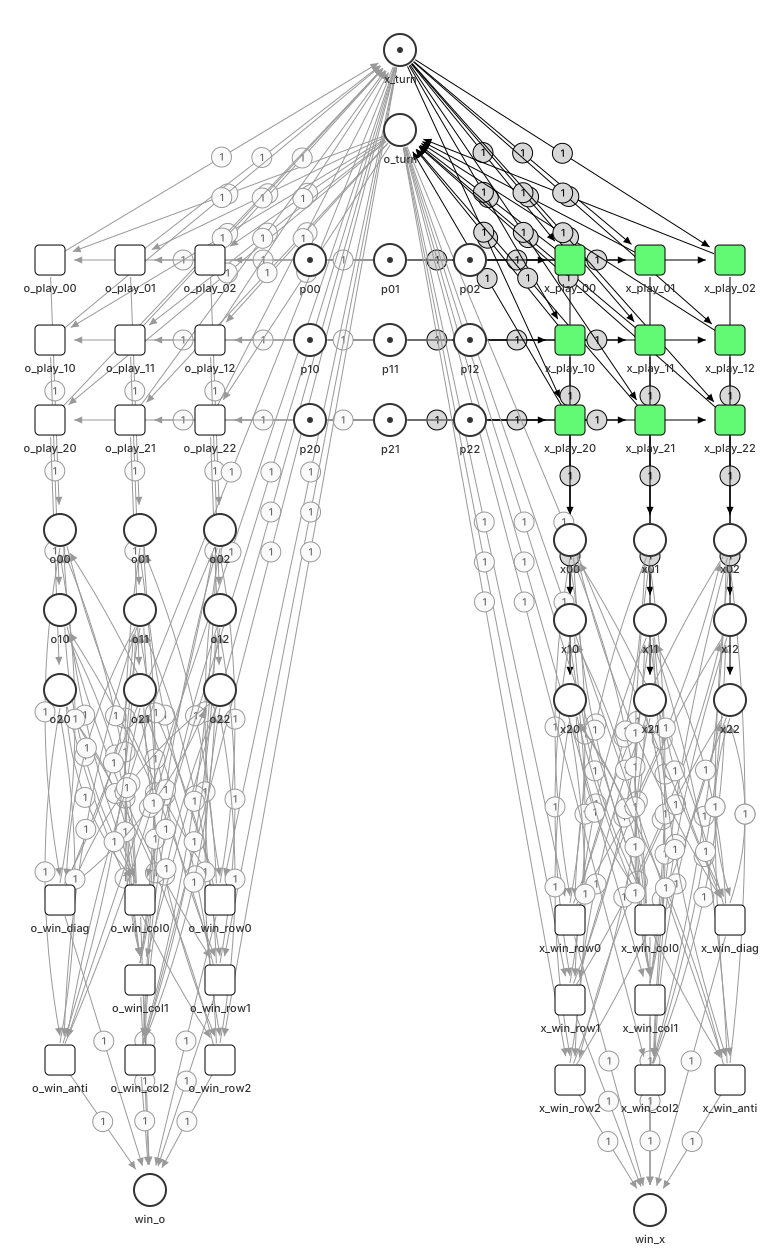
Tic-Tac-Toe
Every board position is a place. ODE heatmaps reveal optimal play from network topology alone.
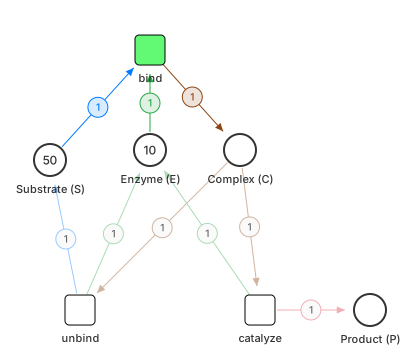
Enzyme Kinetics
Four places, three transitions — mass-action kinetics produce Michaelis-Menten curves automatically.
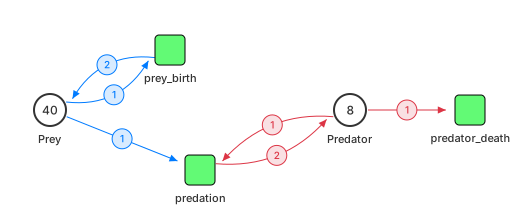
Predator-Prey
Lotka-Volterra dynamics — two species, three reactions, and the ODE solver draws the phase portrait.
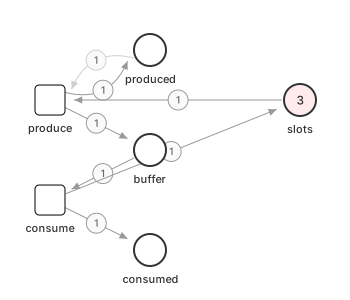
Producer-Consumer
Bounded buffer concurrency — capacity constraints prevent overflow, token counts prove correctness.

USDC Bridge
Cross-chain token flow — IBC to Noble, CCTP burn-and-mint to Base, all as one net.
Draw → Check → Prove
One model, three questions: what is it, what does it do, can it be audited.
Draw
Build state machines visually. Places, transitions, arcs: the model is a directed graph stored as JSON-LD with content-addressed identity.
pflow.xyzCheck
Describe a decision or a process and get back a model that is seeded, repeatable and checked knob by knob, instead of a confident guess. Start from words, not from a canvas.
sim.pflow.xyz →Prove
ZK circuits verify every transition is valid without revealing state. Groth16 proofs from net topology, so the model carries its own audit trail.
Further reading: ZK Petri nets →Go deeper
The editor is the hands-on part. These explain why it works.
The book
A worked introduction to Petri nets: the formalism, the solvers, and the models above taken apart step by step.
book.pflow.xyz →The blog
Technical notes on Petri nets and the systems built on them.
blog.stackdump.com →ZK Petri nets
How a net's topology becomes a circuit, and what a proof of a valid transition does and does not show.
Read the post →Like a list comprehension, pflow starts from a description: say what the system is, and get a model you can run. Then ask it how it is put together, what happens over time, what can't change, what an agent should do, whether reality matches, and whether it is provably right. Under the hood, every model is a Petri net, so runs replay and proofs check.
Try a model on sim.pflow.xyz →