Visual Editor for Petri Nets
Draw a process as places, transitions and arcs, then run it and see what it does. Prefer to start from a description? sim.pflow.xyz turns one into a model you can run and check.
Or start from a description
Describe a decision, process or mechanism to your AI assistant and get back a model you can run and check. Some to open on sim.pflow.xyz:
Example models, open in the editor
Each one is a saved net with a content-addressed ID. Open it, change a weight, run it. The same kind of model is what sim.pflow.xyz builds from a description.
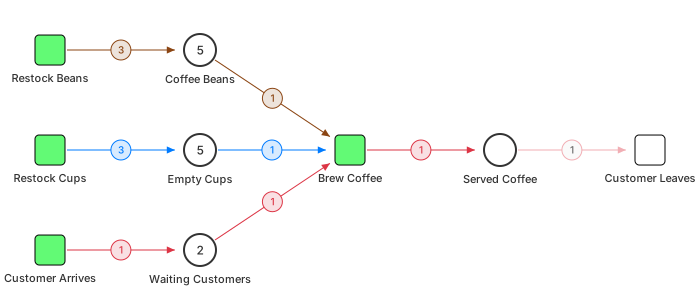
Coffee Shop
Weighted arcs encode recipes, conservation laws guarantee you never oversell a latte.
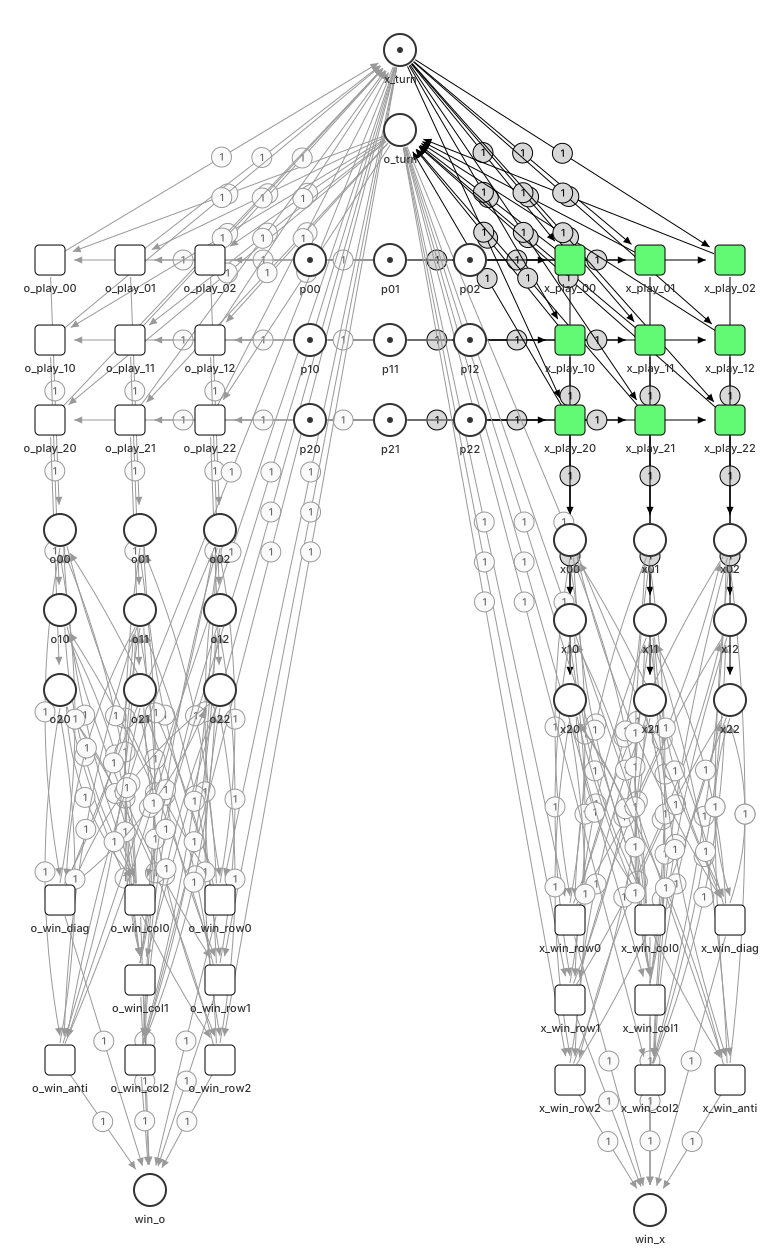
Tic-Tac-Toe
Every board position is a place. ODE heatmaps reveal optimal play from network topology alone.
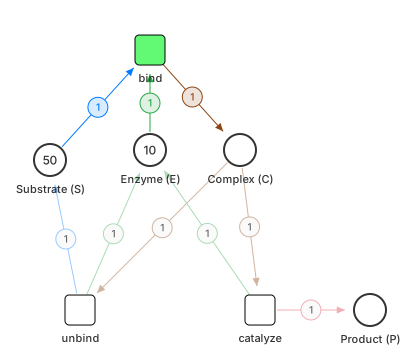
Enzyme Kinetics
Four places, three transitions — mass-action kinetics produce Michaelis-Menten curves automatically.
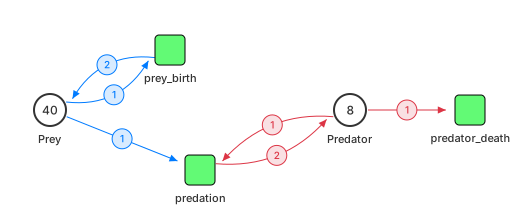
Predator-Prey
Lotka-Volterra dynamics — two species, three reactions, and the ODE solver draws the phase portrait.
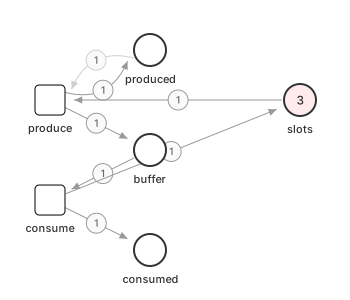
Producer-Consumer
Bounded buffer concurrency — capacity constraints prevent overflow, token counts prove correctness.

USDC Bridge
Cross-chain token flow — IBC to Noble, CCTP burn-and-mint to Base, all as one net.
Draw → Check → Prove
One model, three questions: what is it, what does it do, can it be audited.
Draw
Build state machines visually. Places, transitions, arcs: the model is a directed graph stored as JSON-LD with content-addressed identity.
pflow.xyzCheck
Describe a decision or a process and get back a model that is seeded, repeatable and checked knob by knob, instead of a confident guess. Start from words, not from a canvas.
sim.pflow.xyz →Prove
ZK circuits verify every transition is valid without revealing state. Groth16 proofs from net topology, so the model carries its own audit trail.
Further reading: ZK Petri nets →Go deeper
The editor is the hands-on part. These explain why it works.
The book
A worked introduction to Petri nets: the formalism, the solvers, and the models above taken apart step by step.
book.pflow.xyz →The blog
Technical notes on Petri nets and the systems built on them.
blog.stackdump.com →ZK Petri nets
How a net's topology becomes a circuit, and what a proof of a valid transition does and does not show.
Read the post →Places hold tokens. Transitions move them. Arcs define the rules. From coffee shops to poker games to blockchain bridges, it is the same structure, so the same tools apply.
Try a model on sim.pflow.xyz →